Materials
What “gold plated” actually promises
Plated, filled, overlay, vermeil, washed. Five words that look interchangeable on a label and mean five different thicknesses of metal. The federal wording is short enough to read once and remember.
The word does not mean thickness
A page that says gold plated is telling you about the surface and nothing about what is under it. In this catalogue the answer under it is almost always stainless steel, and we print that in the specification rather than leaving you to guess.
The federal guides set the bar for using the phrase at all, and the bar is durability rather than a number of microns.
Use of the term “Gold Plate,” “Gold Plated,” or any abbreviation to describe all or part of an industry product unless such product or part contains a surface-plating of gold alloy, applied by any process, which is of such thickness and extent of surface coverage that reasonable durability is assured16 CFR § 23.3(b)(5), Federal Trade Commission, read 3 September 2026
How the five words rank
Gold filled and rolled gold plate sit above plating: the guides describe them as a surface layer applied by a mechanical process, which in practice is a sheet of gold alloy bonded to the base rather than deposited on it. Gold overlay is the same family. Vermeil is a separate case defined by its base: sterling silver underneath, gold of at least 10 karat on top.
Gold washed is the thin end, and the guides single out the trick of covering a plated layer with base metal and then washing gold over that. What matters for a buyer is the order of those words, not how expensive the finish looks in a photograph.
We do not use the words gold filled, overlay or vermeil anywhere, because none of these pieces are made that way. 64 of the 562 pieces we list are plated over steel, and the rest are the metal they look like.
Plated pieces in the range
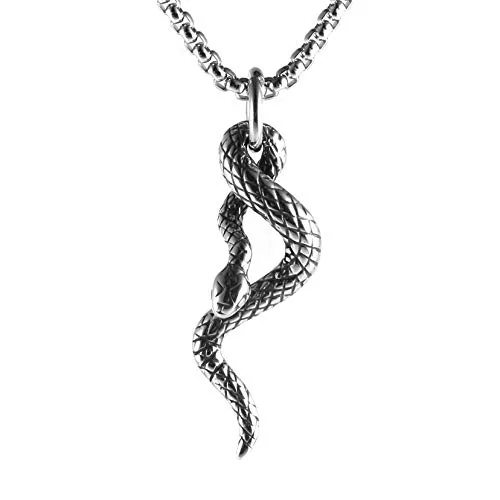
Snake Pendant, stainless steel
4.6 out of 5 from 1,846 ratings
$14.99

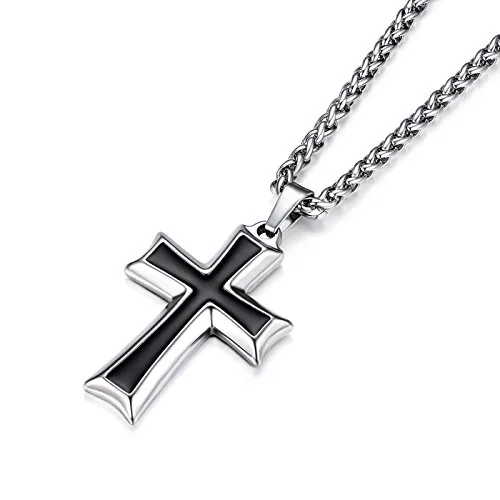
Cross Pendant, stainless steel, wheat chain, 24 in
4.6 out of 5 from 3,819 ratings
$15.70
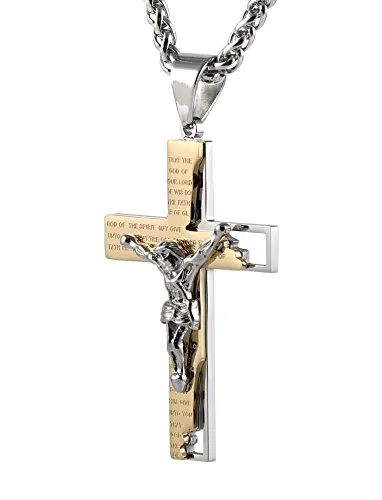
Cross Crucifix Bible Pendant, stainless steel
4.6 out of 5 from 3,276 ratings
$17.99
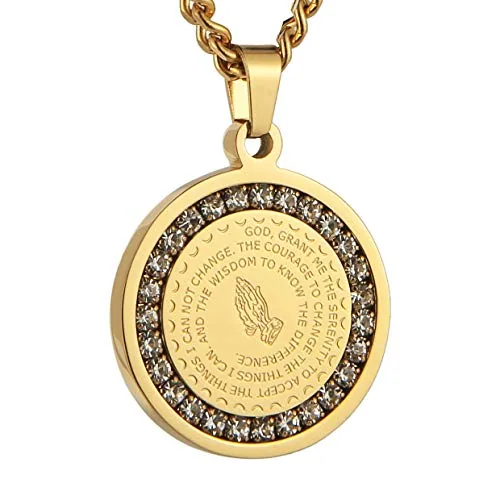
Praying Hands Pendant, stainless steel
4.5 out of 5 from 3,573 ratings
$17.99
Where plating wears first
Plating leaves at contact points, in a predictable order. On a ring it goes at the knuckle side, where your other hand grips it. On a pendant it goes on the back, against the shirt. On a chain it goes at the crown of each link and inside the clasp. On earrings it goes at the post, which is also the part inside your ear, and that matters more than looks if metal bothers your skin.
Two habits buy years. Rotate two pieces instead of wearing one every day, and take plated pieces off before the shower, because soap film dulls a plated surface long before the plating itself is gone.
Steel underneath, and the rust question
Steel is why these pieces survive the treatment plated jewellery normally fails. The same federal guides list which metals may be called corrosion resistant at all, and the phrasing is careful.
Among the metals that may be considered as corrosion (and rust) resistant are: Pure nickel; gold alloys of not less than 10 Kt. fineness; and austenitic stainless steels.16 CFR § 23.11(b), Federal Trade Commission, read 3 September 2026
Resistant is not proof
Resistant and proof are different claims, and the guides treat them differently: proof means immune for the life of the product, resistant means not materially damaged during the major part of it. We use resistant, because that is what steel earns.
421 pieces in this catalogue are stainless steel with no plating at all. They will not change colour, and they also will not warm up to the yellow of gold, which is the trade people make when they choose one over the other.
Sources
- 16 CFR § 23.3, Misrepresentation as to gold content, Federal Trade Commission, Guides for the Jewelry, Precious Metals, and Pewter Industries, read 3 September 2026
- 16 CFR § 23.11, Misuse of “corrosion proof,” “rust resistant,” etc., Federal Trade Commission, read 3 September 2026